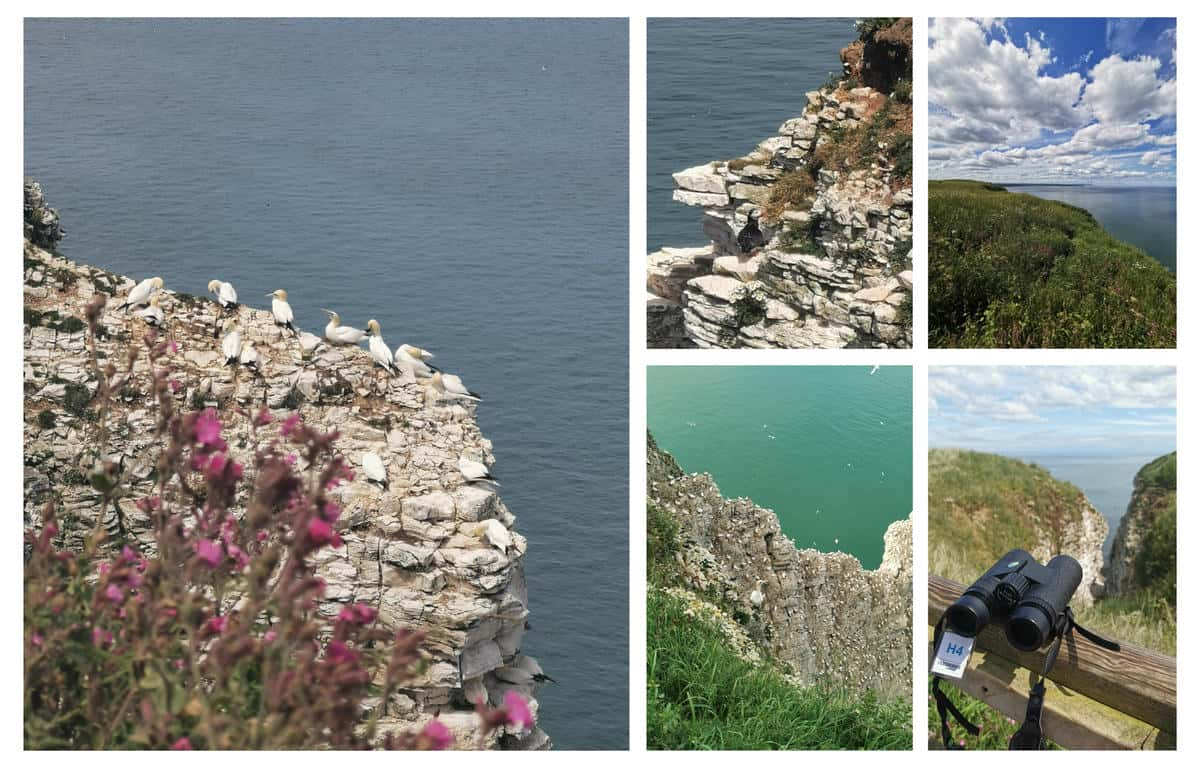
Bempton Cliffs
A towering chalk-cliff seabird city with half a million nesting birds, elusive puffins and England’s only mainland gannet colony
Location: Bempton, East Riding of Yorkshire
Nearest major city: Hull (Kingston upon Hull) / York
Visited: 20 Jun 2026 • Duration: 3-4 hours
Our Take: Standout Experience • Website: rspb.org.uk
Tags: Low-Cost • Step-Free Route • Dogs Welcome
Why visit
Bempton Cliffs Nature Reserve is a unique natural phenomenon. Every year, from March to August, the sheer chalk cliffs of Bempton, reaching heights of 100–120 metres (approximately 330–395 ft), become home to half a million seabirds. It is one of the largest and most accessible mainland colonies in the UK and across Europe.
Bempton Cliffs is a veritable ‘Seabird City’, where the sight of thousands of birds nesting on narrow rocky ledges is accompanied by incredible noise and activity. The sheer number of birds, the constant movement and the nests on every available ledge impress even those with no interest in ornithology whatsoever. The whole scene feels like a wildlife documentary brought vividly to life. Guillemots, razorbills, kittiwakes, fulmars, shags, herring gulls and gannets occupy almost every available ledge.
However, for many visitors, the main attraction is the charming Atlantic puffin – a small bird with a bright, almost painted orange-red beak, often referred to as a ‘sea parrot’. Normally, these birds dig burrows in the ground, but because of the hardness of the chalk, they have to nest directly in the narrow cracks and crevices of the sheer cliffs. Although the puffins are the main attraction at Bempton Cliffs, their small size, modest population (of the half a million birds that nest here, only around 3,000 are puffins) and their lifestyle in the crevices make them difficult to spot. Finding them often requires patience, binoculars and the help of volunteers stationed at the viewing platforms with telescopes. It is therefore best to view an encounter with them as a special seasonal bonus rather than a guaranteed outcome of the trip.
Bempton Cliffs is also England’s only mainland colony of Northern Gannets. Gannets are the UK’s largest seabirds, with a wingspan of up to 2 metres, and are known for their breathtaking dives: when hunting for fish, they plunge into the water from a height at speeds of up to 60 miles per hour (up to 100 km/h).
From the cliffs, it is not uncommon to spot dolphins, porpoises and even minke whales during the summer months.
Unlike many remote island colonies, Bempton Cliffs is accessible to visitors of all abilities. The site features comfortable, safe footpaths totalling around 2 miles in length, and there are five viewing platforms, some of which literally hang over the cliff edge. Some of the routes are fully accessible for wheelchairs and pushchairs. Two all-terrain Tramper mobility scooters are also available free of charge for visitors with limited mobility, with advance booking recommended.
There is a visitor centre, a gift shop (with puffins everywhere) and a café on site.
Dogs are allowed but must be kept on a short lead at all times.
The main car park is small, but on busy days several overflow car parks are opened, and staff help to coordinate the flow of traffic, although congestion is possible on the narrow access road. Parking is included in the admission price.
What else
Bempton Cliffs combines particularly well with Flamborough Head, around 15 minutes away by car, for lighthouse walks, sea arches and a wider exploration of the Heritage Coast. Bridlington and Sewerby Hall & Gardens are both around 20 minutes away, adding either a traditional seaside stop or a quieter country house and gardens.
For a completely different view of the colony, seasonal cruises aboard the historic Yorkshire Belle leave Bridlington Harbour from May to August and approach the cliffs from below. Seeing the towering rock face from the water reveals the true scale of the seabird city, with opportunities to watch gannets and other birds diving into the sea. These cruises are very popular and often sell out well in advance, so early booking is strongly recommended.
Interesting facts
- • Guillemots lay their eggs directly on bare, narrow ledges. Thanks to their unique, elongated pear-shaped form, the eggs do not roll off the cliff into the sea, but simply spin round and round in the same spot.
- • To feed their chicks, the birds sometimes have to cover enormous distances. For example, some puffins fly as far as Dogger Bank in search of sand eels, covering around 50 miles (80 km) in a single foraging trip. Gannets, in search of large fish, can fly around 180 miles (290 km) at a time.
- • Puffins form stable, monogamous pairs and often return year after year to the same partner and nest. During courtship, the birds approach each other, bob their heads and rub their beaks together. The female puffin lays just one egg, which is incubated in turn by both parents. Puffins fly to Bempton Cliffs to nest and rear their young, usually staying there from April until mid-July. The rest of the time they spend mainly on the open sea, swimming, hunting and resting on the water’s surface. Their short wings act like flippers underwater, allowing the birds to ‘fly’ through the water, whilst their feet help them steer. To fly properly, puffins have to flap their wings very rapidly, making several flaps per second. In winter, they no longer look quite so ‘colourful’: the bright outer plates of their beaks fall off, their faces darken noticeably, and their feet become less vividly orange.
- • Chicks at Bempton Cliffs have no safe area for their first flying lessons. Young kittiwakes and gannets remain in the nest for weeks or months until their wings are strong enough, and then leave it for the first time by leaping off the edge of the cliff. But the chicks of guillemots and razorbills make this leap even before they are fully able to fly. At around three weeks old, they follow their father’s call and plunge from a narrow ledge into the sea. Their light weight, thick down and short wings, which act as a primitive parachute, help them survive the fall. Below, the father finds the chick, accompanies it into the sea and continues to feed it until it finally takes to the air.
- • From 2017 to 2022, what is probably the world’s loneliest Black-browed Albatross, nicknamed Albie, regularly returned to Bempton Cliffs; this bird belongs to a species found exclusively in the Southern Hemisphere. It is thought that strong winds blew him off course and carried him into the northern seas, where he was first spotted off the coasts of Denmark and Germany in 2014. Returning home is extremely difficult for him: albatrosses hardly flap their wings at all, conserving their energy by gliding on air currents above the waves. The prevailing winds and the calm zone near the equator could have turned the return journey into an almost insurmountable ordeal. Having encountered no fellow albatrosses here, the enormous bird, with a wingspan of around 2.4 metres, was often seen amongst the Northern Gannets, the only inhabitants of the cliffs comparable to it in size. Albie may still be alive, as albatrosses live for decades, but his current whereabouts and survival have not been confirmed.
- • Until 1954, Bempton Cliffs were the site of one of Yorkshire’s most dangerous trades. Local ‘climbers’ would abseil down from a height of about 120 metres (395 ft) to collect seabird eggs. They usually worked in a team: one man would hang over the sea in a primitive leather harness, another would act as the ‘anchor’, wrapping the rope around his waist and digging his heels into the ground, whilst three others helped to hold them steady at the edge. Once they reached the narrow rocky ledges, the climbers would first collect the beautifully coloured eggs of guillemots and razorbills, which were particularly prized by collectors. The nests of puffins were much harder to reach: they were deep inside crevices, where the collector would often be met with a painful peck from the bird’s beak. In a single day, an experienced climber could collect up to 300–400 eggs, and it is estimated that, on average, around 130,000 were taken from the cliffs each year. Some were eaten or sold to collectors, whilst the rest were used for refining sugar and producing the famous patent leather. The egg yolks were sent to Bradford’s tanneries, where the fat they contained helped give Victorian boots a mirror-like shine. Over time, the climbers’ work itself became a tourist attraction. Some daredevils agreed to abseil down the cliff on a rope; they were sent down for free, but charged for the climb back up. The climbers left every third egg behind to preserve the colony and ensure a supply for the following year. Despite this, in 1954 the collection of wild birds’ eggs was banned by law, and the centuries-old trade came to an end. Follow the link to see what the team’s work looked like in surviving film footage from 1908.
- • During the Victorian era, boats carrying holidaymakers and visiting bird hunters began to sail regularly to the Bempton and Flamborough cliffs; for their own amusement, they shot at the nesting birds, leaving the wounded to die at sea. Local residents had mixed reactions to this new pastime: boatmen earned a living by ferrying the shooters to the cliffs, whilst clergymen, naturalists and landowners demanded an end to the slaughter. One of the most unusual arguments was put forward by MP Christopher Sykes. He told Parliament that, in the fog, the cries of the vast colony served as a natural siren for sailors, warning them of the invisible rocks at Flamborough Head, and that the decline in the bird population was accompanied by an increase in shipwrecks. The birds were even referred to as the ‘pilots of Flamborough’. This argument helped to give the local campaign national significance, and in 1869 the Sea Birds Preservation Act was passed, one of the first modern wildlife conservation laws. Sykes himself was later depicted in a cartoon in Vanity Fair entitled ‘The Gull's Friend’.
Highlights
- • Half a Million Seabirds on Towering Chalk Cliffs
- • Puffins and England’s Only Mainland Gannet Colony
- • Close-Up Wildlife Watching from Five Viewing Platforms
- • Low-Cost Day Out with On-Site Facilities
- • Easy to Combine with Flamborough Head, Bridlington or Sewerby Hall & Gardens
Visitor tips
Professional-grade binoculars are available to hire from the visitor centre. Although the hire cost is relatively high (£10 in 2026), good binoculars transform the experience, bringing birds, chicks and nesting ledges into clear view and making them feel almost within reach. For visitors without their own equipment, they add considerably more detail and interest to the visit.
The sheer concentration of birds creates a strong smell of guano and an almost continuous wall of sound. This is part of the atmosphere of the seabird colony, but the intensity can be overwhelming for visitors who are particularly sensitive to noise or strong smells.
The cliff tops are fully exposed to the North Sea, and conditions can feel cold and windy even during the warmer months. Warm layers, a waterproof jacket and sturdy footwear are particularly useful, especially when the weather is changeable or the paths are wet.
Mobile phone reception around the cliffs can be unreliable, and online maps or live searches may not always load consistently.
Best season: May to early July is the best time to experience Bempton Cliffs at its most impressive, with the greatest concentration of seabirds, constant activity around the nesting ledges and the best chance of seeing puffins around the deep crevices where they breed. Long daylight and clearer conditions also make the colony easier to watch and photograph, although binoculars remain highly valuable. Weather has a major effect on the experience, and a warm, dry and preferably calm day allows more comfortable walks and clearer views. In autumn and winter, most breeding seabirds disperse into the open ocean, and the reserve becomes quieter. Short-eared Owls and migrating birds crossing the North Sea may still appear, but the visit feels less like entering a vast seabird city and more like a dramatic clifftop walk above the winter sea.
Budget tips:
- • RSPB members can visit for free.
- • Children under 5, the first child aged 5–15 in each group and visitors aged 16–24 can visit for free.
- • The public footpath through the reserve can be accessed free on foot from Bempton village, around 1.25 miles (2 km) from the railway station. There is no large official free visitor car park in the village, whilst standard admission includes use of the RSPB car park and helps support the upkeep of the reserve, visitor infrastructure and conservation work.
Public transport: Train to Bempton (Hull–Scarborough line), then a 1–1.5-mile walk to the reserve, partly along a country lane without a pavement.
My verdict
Bempton Cliffs combines an immense breeding colony with towering chalk cliffs and well-designed paths along the edge of the coast. The views are breathtaking in every direction, whether looking down into the crowded nesting ledges or out across the open North Sea. Remarkable birds can be seen at surprisingly close range without specialist equipment, whilst the sheer scale, noise and constant movement of the colony make the experience memorable even for those with little interest in birdwatching. This is a destination worth travelling a considerable distance for, either as a day out in its own right or combined with Flamborough Head, Bridlington or Sewerby Hall & Gardens.